 picosf
 Complex construction sites rarely move one type of material in one direction. Structural steel, masonry products, mechanical components, roofing packages, and finishing materials may need to reach different elevations and work zones. A rotating telehandler can support this workflow by combining lifting, forward reach, and turret rotation. For multi-trade projects, the key question is not simply maximum capacity, but how efficiently one machine can serve changing placement points.
Why Rotation Changes Material Placement
Traditional telehandlers move the chassis to change the direction of placement. A rotating model can swing its upper structure while the base remains positioned, allowing loads to be handled across a broad working area. This can be useful where access routes are limited or several trades need deliveries from different sides of a structure. It may also help reduce repeated driving between nearby placement points, although the achievable benefit depends on load charts, clearances, ground conditions, and the site traffic plan.
The practical benefit depends on the lift plan and site layout. Teams should identify material pickup points, delivery zones, elevation changes, pedestrian routes, and nearby structures before selecting equipment. For complex lifting operations, HSE guidance recommends planning for foreseeable risks, including visibility, overturning, proximity hazards, derating, overload, and pre-use checks.
Match Reach With the Load
Maximum lifting height is only one part of a telehandler decision. Forward reach can become decisive when materials must be positioned beyond obstacles, at slab edges, or into elevated work areas. As boom extension increases, available capacity can change, so procurement teams should review the manufacturer’s load chart for the exact configuration rather than relying on a single headline rating. The same principle applies to elevation and attachment changes, because the usable capacity at one position should not be assumed to apply across every working radius.
This is also why different telehandler types serve different project needs. Fixed-frame machines can suit straightforward material transport and placement, while rotating machines can offer additional positioning flexibility. Buyers should compare lift height, forward reach, rated capacity, dimensions, turning requirements, and attachment compatibility against the actual movement sequence.
Support Several Trades From One Position
Multi-trade sites create competing demands for access equipment. One crew may need pallets placed near a façade while another requires components delivered to an upper floor or roof area. A rotating telehandler can reduce some chassis repositioning by changing boom direction from a stationary base, subject to the machine’s operating limits and site conditions.
This can simplify coordination when several work fronts are close together. However, rotation does not eliminate the need for exclusion zones, communication, load control, or competent operation. HSE guidance states that lifting operations should be properly planned and supervised, with equipment selected and positioned according to foreseeable risks.
Consider Attachments and Task Variation
Construction packages often change as the project progresses. Forks may handle palletized materials during one phase, while another attachment may be needed for a different material-handling task. Buyers should therefore examine the attachment options supported by a telehandler and confirm the approved capacity and operating conditions for each configuration.
Attachment flexibility is one reason telehandler types should be compared by application rather than category name alone. The right machine depends on what must be moved, where it must be placed, and how the load path changes. A project with frequent material variation may benefit from a machine designed to accommodate multiple approved attachments. Procurement should confirm that each attachment is manufacturer-approved and that its rated limits are understood before it is added to the work plan.
ZTH4525R for High-Reach Placement
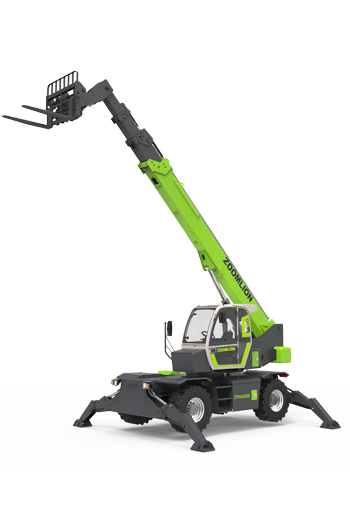
The ZTH4525R from Zoomlion Access is a rotating telehandler with a maximum lift height of 24.8 m and a rated capacity of 4,500 kg. Its official specification lists 2,000 kg lift capacity at maximum height and a maximum forward reach of 19 m, while the lift capacity at maximum reach is 300 kg. These figures should be checked against the specific load chart and placement task.
The model also features 360° continuous rotation, 4×4 drive, hydrostatic transmission, and three steering modes: front-wheel, four-wheel, and crab steering. Its listed minimum ground clearance is 0.35 m, while overall dimensions are 9.28 m long, 2.48 m wide, and 3.15 m high. The machine has a listed gross weight of 17,000 kg.
How Zoomlion Access Fits Multi-Trade Planning
Zoomlion Access provides telehandlers in both non-rotating and rotating configurations. Its published range includes models from 2.5 t to 4.5 t rated capacity, with lifting heights extending from 6 m to 24.8 m. This gives procurement teams several equipment configurations to compare when different phases of a large construction package call for different reach and capacity characteristics.
For a complex site, equipment selection should begin with the material-placement plan, then move to verified specifications, attachment requirements, access constraints, and operating procedures. The ZTH4525R can be evaluated within that framework where high reach, substantial rated capacity, and continuous rotation are relevant to the planned work. Zoomlion Access documentation and project-specific guidance should be reviewed before deployment. This approach keeps equipment selection tied to measurable site demands instead of generic machine labels.