 picosf
Die casting defects are more than isolated quality issues. In production environments, a single recurring defect can increase scrap rates, create additional machining work, delay deliveries, and raise inspection costs. When production volumes increase, these losses can quickly become a significant part of the total manufacturing cost.
For this reason, controlling die casting defects should begin before the first production run. Part design, tooling, material selection, metal flow, cooling, process parameters, and inspection all influence final part quality. A manufacturing partner with engineering and quality capabilities can help identify potential risks earlier and create a more stable production process.
How Die Casting Defects Increase Manufacturing Costs
The visible cost of a defective casting is often only part of the problem. A rejected part may represent wasted material, machine time, labor, and energy. If the defect can be repaired, additional deburring, machining, polishing, welding, or other secondary operations may be required.
Defects can also affect production schedules. When a batch requires additional inspection or rework, downstream machining and assembly may have to wait. If defective parts reach customers, the cost can extend to replacement production, logistics, returns, and potential disruption to the customer’s assembly schedule.
This makes defect prevention an important part of production cost management rather than simply a final inspection task.
Which Die Casting Defects Create Production Problems?
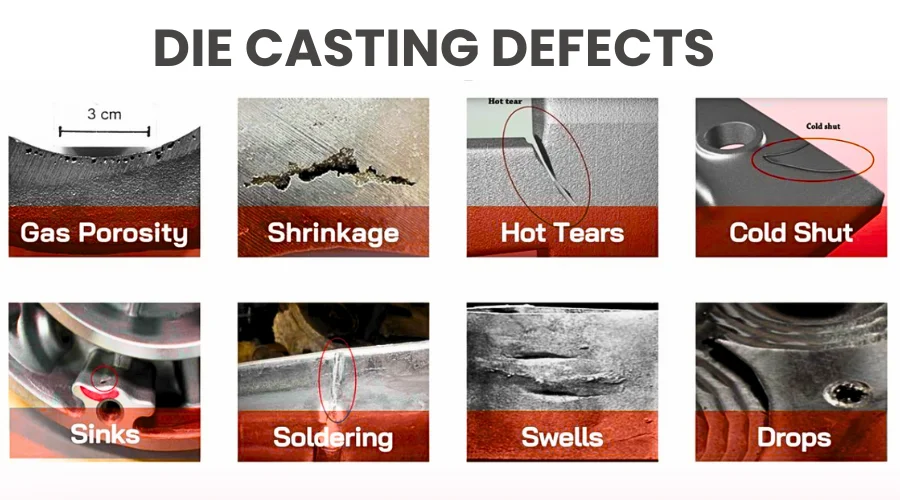
Different die casting defects create different cost mechanisms. Internal defects such as gas porosity and shrinkage porosity may not always be visible during a basic visual inspection, but they can affect strength, pressure tightness, machining performance, or functional reliability. HordRT’s technical guidance identifies porosity as a common die casting issue and connects it with factors such as trapped gas, poor venting, turbulence, and uneven cooling.
Surface defects create another type of production burden. Flash, cold shuts, soldering, and surface imperfections can require trimming, polishing, additional inspection, or even recasting. Excessive flash, for example, can be related to die wear, injection pressure, or insufficient clamping force.
Dimensional defects can be particularly costly when castings must interface with other components. Incorrect dimensions, hole locations, or machining allowances can result in additional machining or part rejection.
Tooling related defects can create repeated problems across an entire production batch. Poor gating, inadequate cooling, worn die surfaces, or unsuitable ejection design may cause the same defect to appear repeatedly. Correcting the tooling early is therefore often more economical than repairing individual castings later.
Why Fixing Defects After Production Is Expensive
Once a defect appears in finished parts, the available solutions become more limited. Minor flash may be removed, small surface imperfections may be polished, and certain porosity issues may sometimes be addressed through additional processing. However, these actions add labor and cycle time and may not restore the original production economics.
The better approach is to identify risk factors during engineering and tooling development. HordRT incorporates DFM review into its manufacturing workflow, with attention to geometry, wall thickness, draft, ribs, bosses, machining areas, and production requirements before tooling proceeds.
How to Prevent Die Casting Defects Before Tooling
Effective defect prevention starts with the part itself. Wall thickness should be reviewed for abrupt transitions and excessively heavy sections because uneven cooling can contribute to porosity, shrinkage, and dimensional variation. Appropriate draft angles support reliable ejection, while fillets and radii can reduce sharp stress concentrations and improve metal flow.
Gating and venting also deserve close attention. The gating system determines how molten metal enters and fills the cavity, while adequate venting helps control trapped air. HordRT’s die casting design guidance highlights wall thickness, draft angles, gating, fillets, and ribs as important considerations for controlling filling, cooling, and ejection.
Material selection should also match the part’s mechanical, thermal, environmental, and dimensional requirements. Choosing an alloy based only on initial material cost can create additional production or performance risks later.
Simulation and engineering review can provide another layer of prevention. By evaluating metal flow and potential problem areas before tooling is finalized, manufacturers can address design or gating concerns before they become expensive tooling changes.
How Process Monitoring Reduces Defect Rates
Even a well designed die cannot compensate for an unstable production process. Casting conditions need to remain within appropriate ranges so that filling, solidification, cooling, and ejection remain consistent.
Process monitoring helps identify variation before it affects a large quantity of parts. HordRT states that key casting parameters are monitored during production, while dimensional and surface inspections are used to verify critical characteristics.
This approach changes quality control from simply checking finished parts to monitoring the process that produces them. For repeat production, that distinction can have a direct effect on scrap and rework.
How Supplier Quality Control Helps Reduce Scrap
A capable die casting supplier should have quality controls at multiple stages rather than relying only on final inspection. Material verification, tooling validation, first article inspection, in process checks, dimensional measurement, and final inspection can work together to identify problems at different points in production.
HordRT’s quality system includes incoming material inspection, in process quality control, and final inspection and documentation. Its die casting quality controls specifically cover alloy and tooling confirmation before production, casting appearance and process checks during production, and dimensional and machined feature checks during final verification.
For projects with tight dimensional requirements, HordRT also provides measurement capabilities including CMM inspection and blue light scanning, depending on project requirements.
How to Evaluate a Die Casting Supplier’s Quality System
When evaluating a supplier, the key question is not simply whether it can produce a sample part. The more important question is whether it can maintain quality when production moves from initial samples to repeated batches.
Review how the supplier handles DFM analysis, first article approval, process capability, dimensional inspection, material documentation, tooling maintenance, traceability, and corrective action. Ask how critical dimensions are monitored and how deviations are handled when they occur.
A supplier with coordinated engineering, tooling, casting, machining, and inspection capabilities can also reduce communication gaps between different production stages. HordRT manages tooling, die casting, machining, surface finishing, and inspection within an integrated manufacturing workflow, allowing quality requirements to be considered from initial design review through production.
How to Calculate the Cost of Die Casting Defects
Looking only at the scrap value can underestimate the real financial impact of defects. A more practical approach is to consider the broader Cost of Poor Quality.
Cost of Poor Quality = Scrap + Rework + Inspection + Delay + Returns
For example, if a casting requires additional machining because of a dimensional issue, the cost includes machining labor and machine capacity as well as the original casting. If a batch requires repeated inspection, additional quality resources are also consumed. If defective parts delay assembly, the impact may extend beyond the casting operation itself.
Tracking these costs helps purchasing and engineering teams evaluate suppliers based on production stability rather than piece price alone.
Controlling Defects for More Predictable Mass Production
A reliable die casting strategy connects design review, tooling development, process monitoring, and quality inspection into one continuous workflow. The objective is not to eliminate every possible variation through final inspection, but to reduce the opportunity for defects to occur in the first place.
HordRT supports this approach with DFM analysis, coordinated tooling and production, process control, dimensional inspection, and quality documentation. Its manufacturing capabilities cover die casting alongside CNC machining, tooling, injection molding, and other secondary processes, allowing different production requirements to be coordinated within one manufacturing workflow.
For projects where production consistency, dimensional accuracy, and cost control matter, this integrated approach can make die casting defects easier to prevent, identify, and correct before they become larger production problems.
A More Predictable Approach to Die Casting Quality
Die casting defects should be treated as a production management issue as much as a quality issue. Porosity, flash, cold shuts, misruns, dimensional variation, and tooling related problems can all create costs beyond the defective part itself.
The most effective strategy is to address potential defects before production through sound part design, DFM analysis, appropriate tooling, controlled casting conditions, and structured inspection. With engineering support and quality control integrated throughout the manufacturing process, companies can reduce unnecessary scrap and rework while creating a more predictable path from tooling to repeat production.
HordRT combines DFM review, tooling development, die casting, secondary machining, and quality inspection to support this production approach, helping customers address quality risks earlier and manage die casting projects from design validation through finished parts.