 picosf
 A camera on a packaging line does more than capture images. It feeds data into a local system that must interpret conditions, trigger an action, and continue working beside motors, sensors, and operators. Vantron’s portfolio places this workload within edge AI embedded systems, where processing, connectivity, and device management operate close to the equipment.
In an engineering context, “Everywhere AI” is a useful shorthand for placing inference across different deployment points rather than sending every data stream to a central cloud. The practical question is how to combine compute, software, I/O, and lifecycle support for each location.
What Does an Edge AI System Actually Include?
An edge AI system has several functional layers. Sensors and cameras collect data. A processor and accelerator prepare that data and run an inference model. The application layer interprets the result, while local interfaces connect the decision to a PLC, robot, display, or network service.
Consider a vision station inspecting labels on a food-packaging line. The system needs to acquire images, control lighting, preprocess frames, classify defects, and signal a reject mechanism. A cloud service may support reporting and model management, but the immediate inspection loop depends on the computer installed beside the machine.
The edge computer also needs storage, diagnostics, and a recovery path. Local inference can reduce the amount of raw video sent across a network, but it does not remove the need for logs, software updates, access control, and application monitoring. These functions belong in the initial architecture rather than being added after deployment.
Compute Modules Set the Inference Envelope
The processor determines which models, camera streams, and application tasks can run within the device’s thermal and power limits. An x86 platform may suit existing Windows or Linux software, camera libraries, and larger peripheral configurations. ARM platforms can fit compact embedded nodes with controlled software images and integrated acceleration.
System-on-Module and Computer-on-Module designs package the processing core as a pluggable compute unit. A carrier board then supplies the application-specific connectors, power circuits, and I/O. This arrangement can shorten hardware redesign work, but a standard module does not remove the need to design and validate the carrier board.
Platform selection also involves the accelerator and its software support. NXP i.MX8 / i.MX9, Qualcomm, MediaTek Genio, Intel, and Rockchip represent processor families that engineers may evaluate for different edge workloads.
The Software Layer Determines Whether AI Runs Reliably
A trained model is not the same as a deployable model. Before selecting hardware, you need to verify the conversion path, supported operators, memory behavior, camera framework, and postprocessing requirements. Unsupported operations may fall back to the CPU, changing response time and thermal load.
Operating-system choice affects the rest of the application. Linux may suit a controlled industrial image, while Windows can simplify integration with existing inspection or control software. Android may fit a dedicated display or kiosk. The category supports Android, Linux, and Windows with SDKs for device-level integration, but each deployment still needs its own driver and application validation.
Edge AI software also has a maintenance lifecycle. Model updates can change memory use and inference time. A new camera driver can affect frame delivery. A failed operating-system update can leave a remote device unavailable. Test installation, rollback, logging, and restart behavior alongside model accuracy.
Connectivity Turns Inference Into Factory Action
Embedded computing becomes useful in a factory when an inference result can reach the correct equipment. A vision result may trigger a PLC output, update a manufacturing record, change an HMI message, or send an alert to a supervisory system. The connection between these functions needs defined timing and failure behavior.
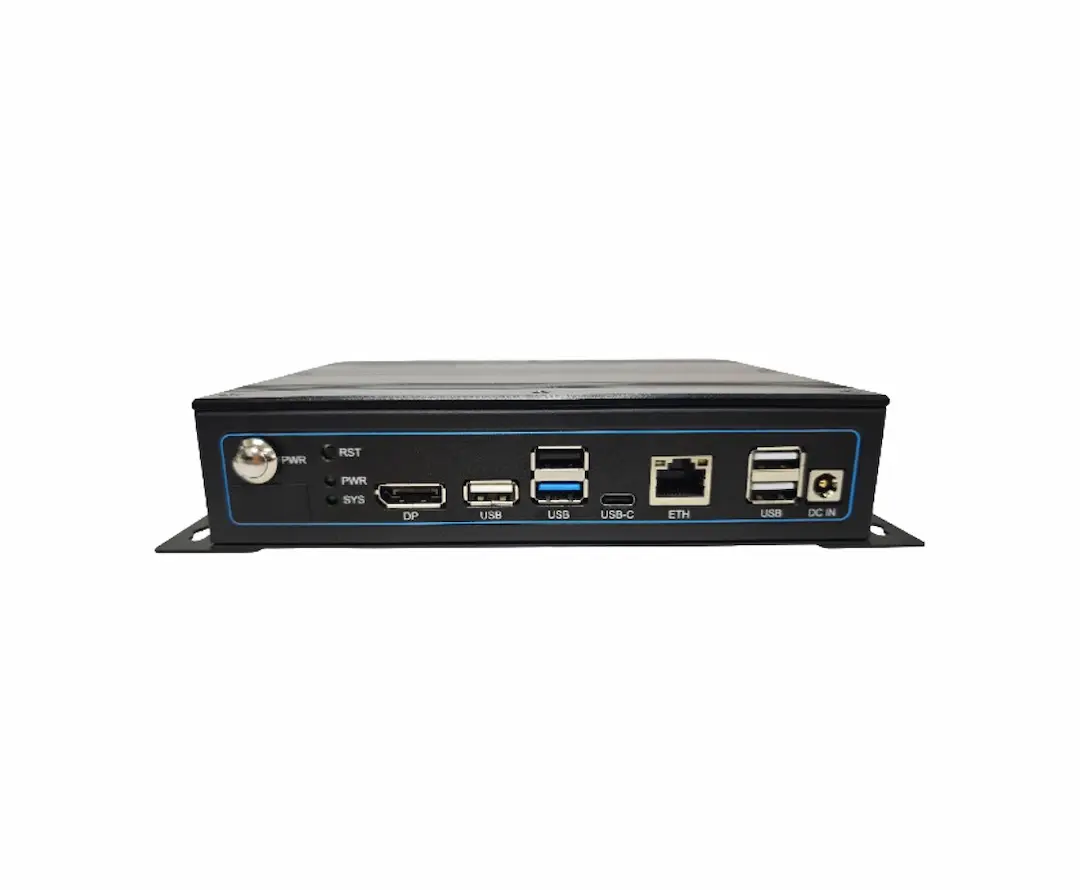
Map every required interface before freezing the design. Record camera links, Ethernet networks, display outputs, serial channels, CAN, digital I/O, storage, and service ports. An AGV or AMR may prioritize sensor and safety I/O, while a warehouse pick station may require multiple cameras, a touchscreen, and a label printer.
The network also needs a role in the architecture. Local processing can keep a machine responsive during intermittent connectivity, while the cloud can handle fleet reporting, model distribution, and long-term analysis. BlueSphere covers mobile-device management and gateway management functions, including provisioning, monitoring, and OTA software lifecycle management.
Select the Building Blocks by Deployment
Start with the physical scene. A camera mounted on an AGV has different constraints from a vision system inside a fixed inspection cabinet. Battery use, vibration, enclosure space, display requirements, camera count, and available network connections all influence the design before processor performance is compared.
Next, define the decision that the system needs to make. A simple presence check may run on a compact edge node. A multi-camera inspection station with 3D perception, display control, and local data handling may require more expansion and acceleration. A GPU-accelerated AI computer can be appropriate, but its complete software pipeline still needs testing.
Lifecycle planning should be part of the same review. Vantron has worked in embedded computing since 2002 and has over 200 research personnel from a variety of fields. Long-lifecycle supply, product lifecycle management, and FAE support can matter when the system will be installed across multiple production sites.
For a project requiring a tailored operating system, interfaces, I/O, enclosure, or logo, Vantron offers OEM/ODM customization. Treat that option as one part of the engineering plan, alongside representative workload testing, network recovery, thermal validation, and a documented update process.